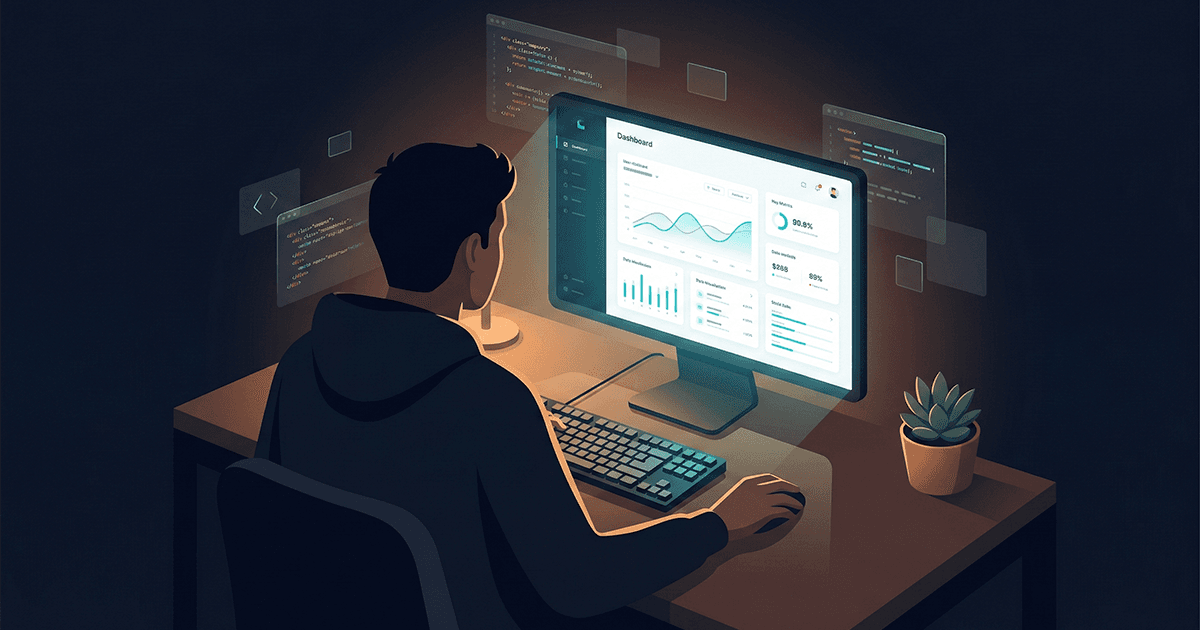
This isn't a marketing post. There's no grand vision statement or five-year roadmap. This is the honest story of why I built Traxpense Flow, why I made it free, and what I'm hoping happens next.
The Frustration That Started It All
I'm a software engineer by profession. I studied Computer Science and Project Management and have spent years building enterprise applications — everything from SAP cloud platforms to full-stack web and mobile solutions. I know how to architect complex systems. But when it came to tracking my own money? Complete chaos.
The year was 2024. I had a full-time job, a couple of side projects generating small amounts of revenue, and absolutely zero clarity on where my money was going.
Every month I'd look at my bank balance and think — where did it all go?
I wasn't spending recklessly. I wasn't ignoring my finances. I was just busy. Work came in waves. Side project income was unpredictable. And keeping track of it all felt like a second job I wasn't getting paid for.
The moment that broke me was tax season. I'd been earning from multiple sources and had no clean record of what came in versus what went out. I spent an entire weekend going through bank statements, trying to separate different income streams from personal expenses, and manually calculating what I owed.
It was miserable. And completely avoidable.
Why Existing Budget Apps Didn't Work
I tried the popular options. I really did.
YNAB wanted me to assign every dollar to a category before I spent it. That's great if you have one predictable salary. When you're juggling a day job and side income that's $2,000 one month and $8,000 the next, envelope budgeting feels like trying to pack a suitcase when you don't know how long the trip is.
Mint (before it shut down) connected to my bank and auto-categorized transactions. Half the categories were wrong. I spent more time fixing categories than I saved by automating them.
Spreadsheets worked brilliantly for about two weeks. Then I'd miss a few days of entries, and the backlog would grow until the spreadsheet became a monument to guilt rather than a useful tool.
The common problem? These tools were either too complex or too rigid. They assumed you had one stable income source and a predictable monthly rhythm. That's not how life works for a lot of us — freelancers, side hustlers, students, or anyone whose income doesn't arrive in a neat bi-weekly paycheck.
What I actually needed was dead simple:
"What came in, what went out, and what's safe to spend — after taxes."
Three numbers. That's it.
The Decision to Build Something Simple
I'm a developer. When something bothers me enough, I build a solution. It's a blessing and a curse — and it's how most of my late nights start.
The first version was a weekend project. No design system, no fancy features. Just a form to add income, a form to add expenses, and a dashboard that showed me one number: what's safe to spend.
I started using it immediately. Not because it was good — it wasn't, not yet — but because it answered the one question I actually cared about. Within a week, I was logging every transaction. Not because I forced myself to, but because it took five seconds and the dashboard actually changed in a way that felt meaningful.
That's when I knew I was onto something. The tools I'd tried before failed because they asked too much. This worked because it asked almost nothing.
Tech Choices and Building Solo
I picked the stack based on one criterion: what can I build and ship fastest, alone?
Next.js because I already knew React well from my day job and the App Router gave me server components out of the box — fast initial loads without a separate API layer.
Supabase because it handles authentication, database, and row-level security without spinning up a backend. One less thing to maintain when you're a team of one.
Tailwind CSS because I can build UI fast without fighting CSS naming conventions or managing stylesheets. After years of working with design systems at scale, I appreciate the speed of utility-first CSS for solo projects.
TypeScript everywhere because catching bugs at build time is cheaper than catching them in production — a lesson I've learned the hard way on larger codebases.
The entire app runs on Supabase's free tier. The hosting is on Vercel's free plan. My operational cost is essentially zero, which matters when you're building something without funding or revenue.
Building solo means making trade-offs. Every feature I add is a feature I have to maintain after work hours. So I've been ruthless about saying no to complexity. No bank API integrations. No AI-powered categorization. No social features. Just the basics, done well.
From CreatorBudget to Traxpense Flow
The project started as CreatorBudget. The name made sense at the time — I was building it for content creators and freelancers who needed a simple budget tool.
But as I used it more, I realized two things. First, it wasn't really a budgeting app. Budgeting implies you're planning how to spend future money. This tool was about tracking — understanding where money came in and where it went. The value wasn't in the plan, it was in the visibility.
Second, the audience was way broader than content creators. Students needed this. Families needed this. Anyone juggling irregular income needed this. Limiting it to "creators" was leaving people out.
Traxpense is a portmanteau of "track" and "expense." Flow was added because the core philosophy is about cash flow, not budgets. Money flows in, money flows out, and you need to see the flow clearly.
The rebrand also felt like a signal — to myself as much as anyone — that this was becoming something real, not just a side project I'd abandon in two months.
Why It's Free During Beta
I get asked this a lot. "What's the catch?" There isn't one. Here's the honest answer:
I'm still figuring out what this should become.
I know the core — income tracking, expense tracking, tax awareness — is valuable. I use it every day. But I don't know yet what features people will actually pay for. I don't want to charge for something and then discover I built the wrong premium features.
So the beta is free because:
- I want real users giving real feedback. Not friends being polite, not hypothetical personas in a product doc. People who actually use it for their actual money.
- I want to earn trust before asking for money. If you're going to trust an app with your financial data, you should at least get to try it first with no pressure.
- The cost is near zero. Supabase and Vercel free tiers mean I'm not burning money keeping this alive. There's no investor pressure to monetize immediately.
Eventually there will be a paid tier. I'm thinking it'll be for power features — recurring transactions, advanced reports, multi-currency support. The basics will likely stay free forever.
But I'd rather get the product right first and figure out the business later. That might not be the smartest business strategy, but it's an honest one.
What's Coming Next
The roadmap is short and intentional:
- Recurring transactions — subscriptions, rent, regular retainers. Things you shouldn't have to re-enter every month.
- Budget goals — simple targets per category. "Spend less than X on food this month."
- Monthly overview charts — visual breakdowns of where your money went.
- Mobile app — eventually. The web app works on mobile, but a native app would be faster.
What I'm not building: bank integrations, AI categorization, social comparisons, gamification. Those features aren't bad — they're just not what this tool is about. Traxpense Flow is about simplicity, and that means saying no to most ideas.
An Invitation
If you're a freelancer, a side hustler, a student, or anyone whose income doesn't follow a predictable pattern — I built this for you. Specifically for you.
I'd love for you to try it. Not because I need the numbers, but because I need the feedback. Every feature decision I make should be informed by people who actually use this thing in their real lives.
Ready to track smarter?
Start tracking your expenses and income for free — no credit card required.
Start for Free →And if something is broken, confusing, or just annoying — tell me. I'm one developer building this in public, and I'd rather hear "this is frustrating" now than discover it after I've built three more features on top of a broken foundation.
You can reach me through the app, or just reply to any email you get from Traxpense. It goes to my actual inbox. No support team, no ticket system. Just me.
Thanks for reading. And thanks for giving a solo project a chance.