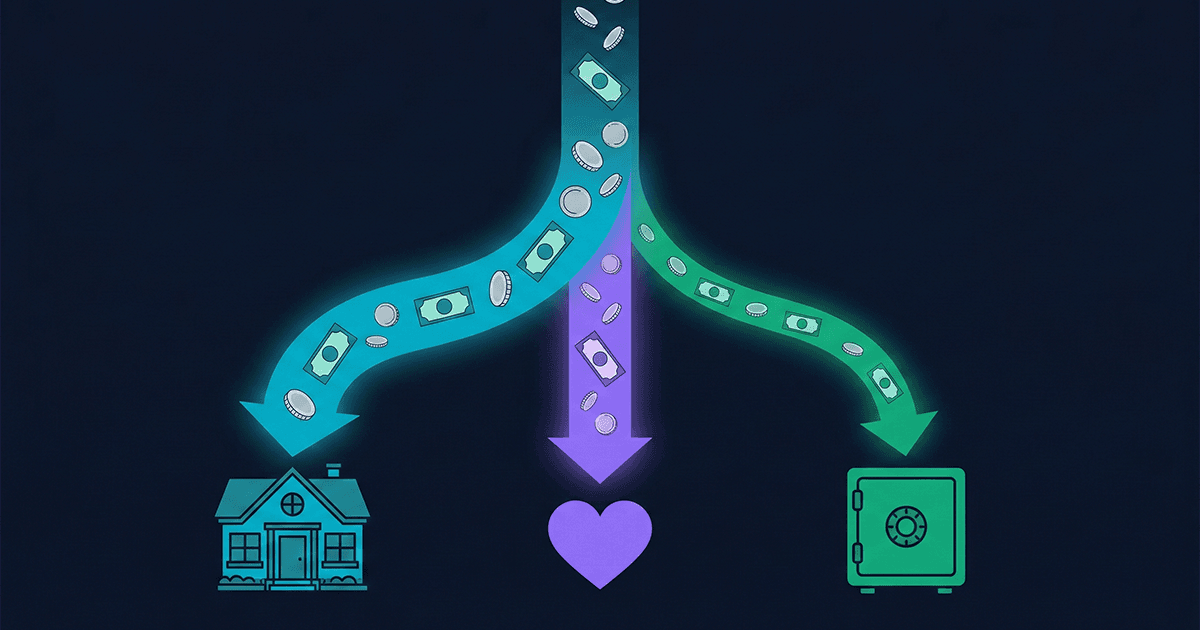
The 50/30/20 rule is probably the most famous budgeting framework ever created. Senator Elizabeth Warren popularized it in her 2005 book All Your Worth, and it's been repeated in every personal finance article since.
The appeal is obvious: three numbers, one simple system. But does it actually hold up in 2026, when rent alone can eat 50% of your income and "needs" vs. "wants" isn't as clear as it used to be?
Let's break it down honestly.
What Is the 50/30/20 Rule?
The rule divides your after-tax income into three buckets:
- 50% — Needs: Housing, groceries, utilities, insurance, minimum debt payments, transportation. Things you genuinely can't live without.
- 30% — Wants: Dining out, entertainment, subscriptions, vacations, shopping. Things you enjoy but could technically survive without.
- 20% — Savings & Debt Repayment: Emergency fund, retirement contributions, extra debt payments beyond minimums, investments.
If you take home $5,000/month after taxes, the breakdown looks like:
| Category | Percentage | Amount |
|---|---|---|
| Needs | 50% | $2,500 |
| Wants | 30% | $1,500 |
| Savings | 20% | $1,000 |
Simple, memorable, and reasonable. That's why it's lasted 20 years.
Where the Rule Works Well
The 50/30/20 framework genuinely works for a specific kind of financial life:
Stable, Predictable Income
If you get the same paycheck every two weeks, you can calculate your buckets once and check in occasionally to make sure you're on track. The predictability makes the percentages meaningful.
Moderate Cost-of-Living Areas
If you live somewhere where rent is 25-30% of your income, keeping total needs under 50% is realistic. There's room for groceries, insurance, and utilities without the math falling apart.
As a Starting Framework
For someone who's never budgeted before, 50/30/20 is a brilliant starting point. It doesn't require tracking every dollar. It doesn't require categories or spreadsheets. It's three numbers that give you a general sense of whether your finances are balanced.
When You Need Permission to Spend
Some people are natural over-savers. They feel guilty about every discretionary purchase. The 30% "wants" allocation explicitly says: it's okay to enjoy your money. That psychological permission has real value.
Where the Rule Breaks Down
Here's where it gets real.
High Cost-of-Living Cities
If you live in New York, San Francisco, London, Sydney, Toronto, or any major metro, the 50% needs allocation is often a fantasy.
Let's say you earn $5,000/month after tax in NYC. Average rent for a one-bedroom apartment is roughly $3,500. That's 70% of your income on housing alone — before groceries, utilities, transportation, or insurance.
Even with roommates bringing rent down to $1,800, you're at 36% just for housing. Add groceries ($500), transit ($130), phone ($80), health insurance ($300), and minimum student loan payments ($250), and your needs are at $3,060 — that's 61%.
The 50/30/20 rule doesn't account for geographic reality. If you live in an expensive city, the math simply doesn't add up at median income levels.
Irregular Income
Freelancers, contractors, gig workers, commission-based employees — if your income fluctuates, percentages become moving targets.
How do you calculate 50% of your income when you made $3,000 last month and $9,000 this month? Do you use an average? Which average? The last three months? Last year? Should your "needs" spending change monthly based on income, or should it stay fixed?
The rule assumes steady state. Irregular income isn't a steady state.
Debt-Heavy Situations
If you're carrying significant debt — student loans, credit card balances, medical debt — the 20% savings allocation splits between saving and debt repayment. For someone with $40,000 in student loans and $8,000 in credit card debt, 20% might be almost entirely consumed by minimum payments plus a small extra principal payment.
That leaves nothing for an emergency fund, nothing for retirement. The rule technically works, but the 20% bucket is doing too much for one allocation.
The "Needs" vs "Wants" Problem
Here's the philosophical issue: the line between needs and wants is blurry in 2026.
- Is internet a need or a want? (It's a need if you work remotely.)
- Is a gym membership a need or a want? (Depends on whether you consider mental health maintenance a need.)
- Is a phone a need or a want? (Try functioning in modern society without one.)
- Is childcare a need or a want? (Obviously a need, but it can cost $2,000+/month.)
- Are subscriptions needs or wants? (Netflix is a want. Cloud storage for work is a need. What about Spotify when music genuinely helps your mental health?)
Most real-life expenses exist in a gray zone that the rule doesn't address.
It Ignores Taxes for Non-Salaried Workers
The rule starts with "after-tax income." For salaried employees, taxes are automatically deducted from each paycheck. Your take-home pay is already post-tax.
For freelancers and self-employed workers, taxes aren't withheld. Your gross income and your after-tax income are two very different numbers, and you're responsible for calculating and paying the difference yourself — usually quarterly.
If you earn $6,000 in a month and your effective tax rate is 25%, your after-tax income is $4,500. But that $1,500 for taxes is still sitting in your bank account, looking like spendable money. The 50/30/20 rule doesn't help you separate it.
Practical Alternatives to 50/30/20
The 60/20/20 Rule (for High-COL Areas)
If needs consistently exceed 50%, adjust the framework rather than pretending the math works:
- 60% — Needs (accepting the reality of your cost of living)
- 20% — Wants (reduced but still present)
- 20% — Savings & Debt
This is less "ideal" on paper but far more achievable for people in expensive cities. An achievable budget you follow is infinitely better than an ideal budget you abandon.
The 80/20 Rule (Simplified)
Forget the categories. Just follow one rule:
- Save 20% first. Automate it on payday.
- Spend the other 80% however you want.
No tracking needs vs. wants. No guilt about which bucket something belongs in. Just save first, then live your life. This works well for people who resist detailed budgeting but can commit to one automated action.
The Zero-Based Approach (YNAB Style)
Instead of percentages, assign every dollar to a specific purpose:
- Every dollar of income gets allocated to a category
- Spending happens within those allocations
- When a category runs out, you stop or move money from another category
This is more work than 50/30/20, but it's more accurate for people with complex financial lives. It's the core of YNAB's methodology, and it works well if you're willing to invest the time.
The Flow Method (Traxpense Approach)
Instead of pre-allocating money into buckets, track what actually happens and adjust:
- Log income as it arrives. Tag it by source so you know where it's coming from.
- Log expenses as they happen. Categorize them so you know where it's going.
- Set tax aside automatically. Apply your tax rate to each income entry so the dashboard reflects spendable money, not gross income.
- Review the dashboard weekly. See the real numbers — income, expenses, and what's safe to spend.
This is reactive rather than proactive. You're not planning how to spend; you're observing how you actually spend and making adjustments when the numbers don't look right.
The advantage? It works with irregular income because it tracks actuals, not projections. There's no "what should 50% be this month?" question because you're looking at real data, not theoretical allocations.
How to Use 50/30/20 as a Benchmark (Not a Rule)
The smartest way to use the 50/30/20 framework in 2026 isn't as a strict rule — it's as a diagnostic tool.
Track your actual spending for a month. Just log everything. Don't try to change your behavior; just observe it. At the end of the month, calculate your real percentages.
Then compare:
- Needs over 50%? You might be in a high cost-of-living area (not your fault) or spending on "needs" that are actually wants (addressable).
- Wants over 30%? This is usually where the easy wins are. Subscriptions you forgot about, dining out more than you realized, impulse purchases that felt small individually.
- Savings under 20%? This is the alarm bell. If you're saving less than 20% and you're not actively paying down debt, something needs to change.
The percentages aren't commandments. They're a lens for understanding your financial picture. You might end up at 55/25/20, or 45/35/20, or something entirely different. That's fine. The point is awareness, not adherence.
Tracking Your Ratios With Traxpense Flow
Here's how Traxpense makes this practical:
Step 1: Log your income and expenses for a full month. Every transaction, no exceptions. It takes five seconds per entry.
Step 2: Use categories to tag expenses. "Rent" and "groceries" are needs. "Dining out" and "entertainment" are wants. Savings transfers go to budgets.
Step 3: Check your dashboard. The pie chart shows category distribution. The numbers show total income vs. total expenses. The tax calculator shows what you actually have to work with.
Step 4: Compare your real numbers against the 50/30/20 benchmark. Are you close? Way off? Is the gap because of lifestyle choices or structural costs?
The goal isn't to hit 50/30/20 exactly. The goal is to see clearly — and then make changes that actually make sense for your life.
Ready to track smarter?
Start tracking your expenses and income for free — no credit card required.
Start for Free →The Real Rule
Here's the only budgeting rule that universally works:
Spend less than you earn and save the difference consistently.
Whether you do that through 50/30/20, zero-based budgeting, the 80/20 rule, or just obsessively checking your Traxpense dashboard — the method doesn't matter. What matters is that you're paying attention.
The 50/30/20 rule is a decent starting point. It's not gospel. Use it as a compass, not a map. Adjust the percentages to fit your reality. And if your reality doesn't fit any framework at all, that's fine too — just track what's happening and make intentional decisions about what to change.
That's all personal finance really is: paying attention and making choices. Everything else is just a framework to help you do those two things.
Read next: How to Save Money Each Month on Any Salary — practical strategies that work alongside whatever framework you choose.